
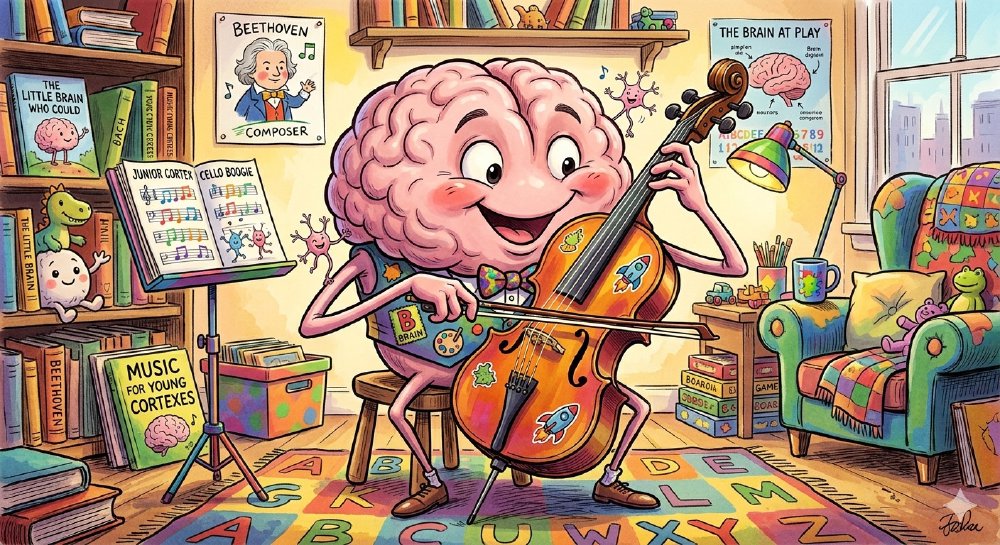
Many parents in Bukit Timah wonder if music lessons are worth the time and investment. Beyond learning to play an instrument, can music education actually help your child perform better academically?
The answer is yes — and science backs it up. Studies around the world have shown that learning music supports brain development, strengthens cognitive skills, and improves social and emotional well-being. Here is how.
Enhances Brain Development
Learning music engages both sides of the brain. This helps children develop connections between regions responsible for language, memory, and problem-solving.
A study published in Nature Reviews Neuroscience found that musical training shapes the brain’s structure and improves abilities beyond music itself.
Reference: Music Training Shapes Structural Brain Development
Better at Mathematics
Practising an instrument strengthens working memory and attention span — skills essential for doing well in school.
The most highly publicised mental influence of music is the Mozart effect. Struck by the observation that many musicians have unusual mathematical ability, researchers at the University of California, Irvine, investigated how listening to music affects cognitive function in general, and spatial-temporal reasoning in particular.
Reference: The Mozart Effect — Journal of the Royal Society of Medicine
Helps Learn Foreign Languages
Growing evidence shows that music and language experience affect the neural processing of speech sounds throughout the auditory system. Recent work has focused on the benefits induced by musical practice on the processing of native language and tonal foreign languages, both of which rely on pitch processing.
Reference: Musical Training Enhances the Automatic Neural Processing of Foreign Speech Sounds — Nature
Builds Discipline and Time Management
Practising an instrument teaches children discipline, patience, and time management — qualities that benefit every area of learning.
A longitudinal study published in the National Library of Medicine reported that sustained music training over years was associated with improvements in executive function, such as planning and impulse control.
Supports Emotional Well-Being
Performing music gives children a sense of accomplishment and builds confidence. Studies have also found that music can reduce stress and anxiety.
According to a study in the Journal of Positive Psychology, group music-making promotes positive moods and social bonding.
Reference: The Transformative Power of Music — National Library of Medicine
Help Your Child Thrive
In Singapore’s high-achievement school environment, music lessons can be a healthy outlet that nurtures creativity while supporting academic success. At our music school located conveniently at the exit of King Albert Park MRT station, we see first-hand how children grow in confidence and focus with each lesson.
If you would like to discover how music can help your child excel, we invite you to book a trial lesson with our experienced teachers.